
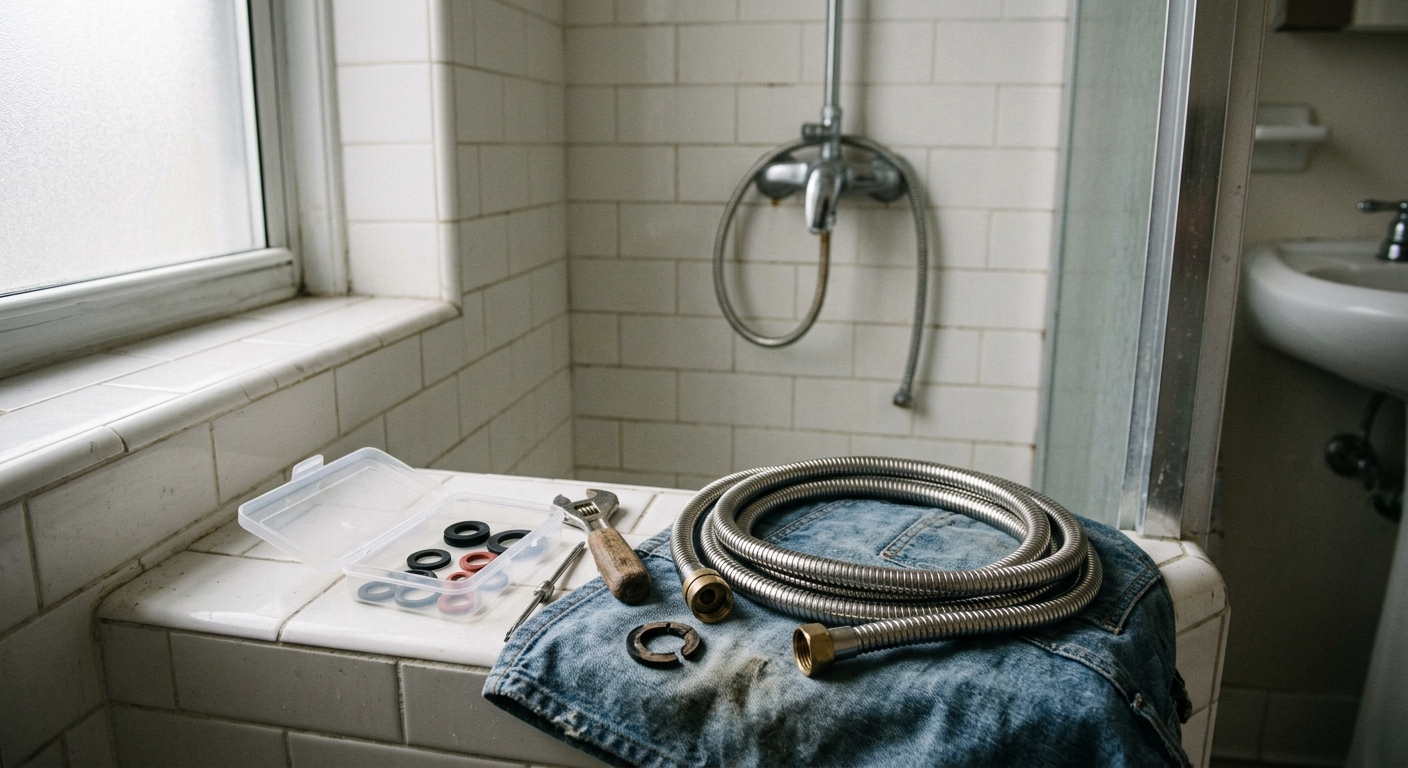
Plan on replacing shower hoses every 12 to 18 months in hard water areas, sooner in properties running above 120 ppm hardness, and treat washers as a consumable you swap at every hose change plus at least once between cycles. Run this as a scheduled batch across the property rather than a work-order-by-work-order repair, staggered by floor or wing so you never have two guest floors down at once. The failure pattern is predictable enough to plan around, which is the point.
Why hoses fail faster than the fixtures around them
A shower hose is the weakest link in the assembly by design. It flexes with every use, sits in a wet environment that never fully dries, and takes the brunt of mineral scale because it has the smallest bore and the most internal surface area relative to flow. The braided outer layer corrodes at the crimped ends first, which is also where the rubber inner core cracks from repeated flexing. Valves, showerheads, and arms are static once installed and see none of that mechanical stress, so they routinely outlast hoses by a factor of three to five.
Hard water accelerates this. Scale builds inside the hose wall and at the washer seat, restricting flow and creating pressure points that stress the braiding. In properties on well water or municipal supply above roughly 120 ppm hardness, expect the low end of the 12 to 18 month range. Softened or lower-hardness supply can push a hose past 18 months, but treating that as the default plan risks in-room failures during occupancy rather than during scheduled turns.
Thread sizes and washer types, and why the distinction matters at scale
Most hotel shower hose connections use 1/2-inch BSP thread on both the wall elbow and the handset end. This is the near-universal standard across commercial and residential fixtures in markets that follow BSP conventions, and it means your parts inventory can be simplified to one thread size for the vast majority of rooms. Confirm this against your actual fixture spec sheets before bulk ordering, since older properties or mixed-brand renovations sometimes carry NPT fittings on a subset of rooms.
Washers are where a lot of maintenance teams lose time on preventable callbacks. There are two types in common use, and they are not interchangeable:
- Flat rubber washers seal against a flat seat and are standard on most modern hose connections. They compress evenly and are the correct choice for BSP fittings with a flat face.
- Cone washers seal into a tapered seat and appear on older fittings or certain handset designs where the connection geometry is conical rather than flat. Using a flat washer in a cone seat, or vice versa, produces a slow weep leak that looks like a hose failure but is actually a washer mismatch.
Stock both types. A single wrong washer on a callback wastes a technician trip and, more importantly, wastes the housekeeping or front-desk time spent fielding the guest complaint that prompted the callback in the first place.
Building a phased replacement schedule
Tie the replacement cycle to your room inventory turns rather than running it as a reactive maintenance queue. A property with year-round occupancy should segment rooms by floor or wing and replace hoses and washers in that segment during a defined low-occupancy window, then move to the next segment on a rolling basis. This keeps any given week’s disruption confined to one part of the building and gives housekeeping and engineering a predictable rhythm instead of a constant trickle of individual work orders.
A simple phased schedule for a mid-size property might look like this:
| Phase | Scope | Timing |
|---|---|---|
| 1 | Floors 1-3 (highest turnover, highest hardness exposure if fed from a shared riser) | Month 1 |
| 2 | Floors 4-6 | Month 4 |
| 3 | Floors 7-9 | Month 8 |
| 4 | Remaining floors plus suites and ADA rooms | Month 12 |
Adjust the interval to your occupancy calendar and water hardness data, but the principle holds regardless of property size: never schedule a full-property hose swap in a single window unless the property is closed for a larger renovation. During any full bathroom refresh, this is also the point where it makes sense to evaluate whether the existing valve and head assembly should be upgraded alongside the hose, particularly if you are already sourcing thermostatic shower systems for ADA compliance or scald-control reasons on that floor.
Batching purchases across room blocks
Ordering hoses and washers in bulk tied to your phase schedule, rather than one at a time as failures occur, is where the cost savings actually show up. Per-unit pricing on hoses drops meaningfully at case quantities, and batching also lets you standardize on a single hose length and finish across a room block instead of carrying mismatched inventory from piecemeal orders placed under time pressure. Order washers in bulk separately from hoses since they turn over faster and a stockout on a $2 part should never be the reason a room goes out of service.
Keep a running par level in the engineering storeroom based on room count: a property with 200 guest rooms running an 18-month cycle needs roughly 11 to 14 hose replacements per month on average once you include failures outside the scheduled phases, so size your par stock and reorder point around that number rather than around the phase quantity alone.
Training housekeeping to flag early wear
Housekeeping is in every room daily and is your earliest warning system for hose wear, but only if staff know what to look for and have a fast way to report it. Train room attendants to flag three specific conditions rather than asking them to make a judgment call on whether something “needs maintenance”:
- Visible kinking or flattening in the hose, especially near the wall or handset connection
- Rust or green discoloration on the braided exterior
- Any drip at the wall connection when the shower is off, which usually indicates a failing or mismatched washer rather than the hose itself
Route these reports through a simple flag system, whether that is a note on the housekeeping app, a colored tag left in the room folder, or a line item on the daily inspection sheet, so engineering can fold them into the next scheduled phase instead of dispatching a same-day repair for a non-emergency. Reserve same-day dispatch for active leaks or complete hose failure.
Logging replacements for capex forecasting
Every hose and washer swap should be logged by room number, date, and reason (scheduled phase versus early failure). Over two or three cycles this log tells you which floors or wings are running short of the 12 to 18 month baseline, which is usually a water hardness or pressure issue worth escalating rather than a fixture defect. It also gives you the data to forecast next year’s parts budget with actual failure rates instead of a flat estimate, and it flags when a full shower system replacement, not just a hose swap, is the more cost-effective move on a given floor.
What to check next
Pull your current water hardness report and cross-check it against your last known hose replacement dates by floor. If any floor is running past 18 months with no logged replacement, move it to the front of the next phase regardless of where it falls on the rotation. Confirm thread type on any room block you have not audited recently, and make sure your storeroom carries both flat and cone washers before the next scheduled phase begins.
