
Hospitality Bathroom Design, Fixtures, Sensory Experience & Sustainability
We are a nonprofit, educational resource for AEC teams working on hotels, resorts, wellness destinations,
serviced apartments, cruise ships, and mixed-use hospitality developments. Every answer is fully visible
for readers and search engines, with brand references used only as examples, not endorsements.
Example brand resources (non-endorsement):
FontanaShowers ·
BathSelect.com ·
BathSelectHospitality.com ·
JunoShowers ·
BravatShowers
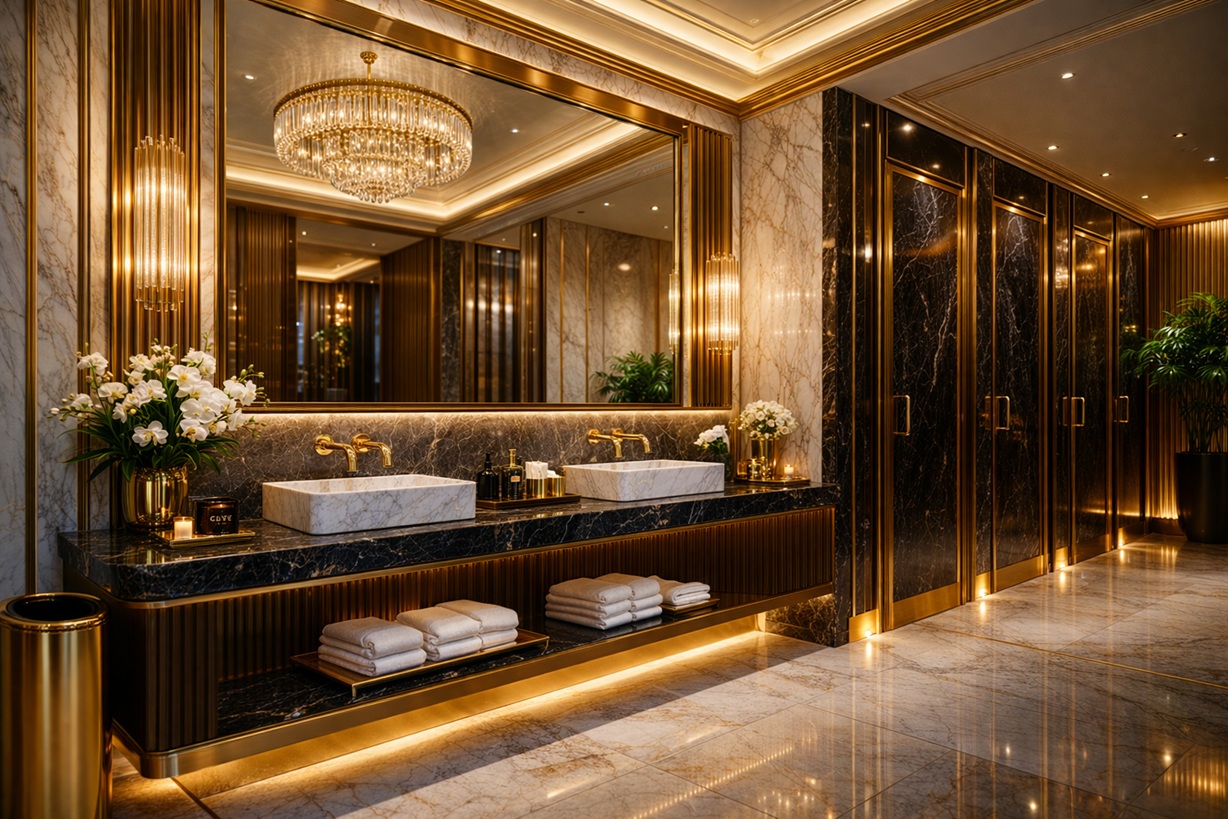
must perform under real cleaning cycles, humidity, and long-term use.
Hospitality Bathroom Design in the Modern Hotel Industry
We define hospitality bathroom design as an AEC discipline balancing guest experience, durability, hygiene confidence,
sustainability, and lifecycle cost in guestrooms and public-area restrooms.
What is hospitality bathroom design?
Hospitality bathroom design focuses on hotel and resort bathrooms as performance environments, not decoration.
We evaluate layout, accessibility clearances, waterproofing, ventilation strategy, materials, and fixtures as one coordinated system.
The objective is a consistent guest ritual—quiet, intuitive, and premium—while still remaining maintainable under daily housekeeping and long-term asset ownership expectations.
Why are bathrooms critical to hospitality brand perception?
Bathrooms often carry disproportionate brand meaning because they visibly signal cleanliness, investment quality, and operational competence.
Guests notice temperature stability, mirror lighting, grout lines, drainage behavior, and fixture feel immediately.
Even in compact rooms, a high-performing bathroom can elevate perceived value, while a minor leak or staining can trigger negative reviews and reduced repeat intent.
How has the role of bathrooms evolved in hospitality design?
Bathrooms have moved from purely functional spaces into experiential “wellness moments” that express brand identity.
Designers increasingly create spa-like calm using layered lighting, warm materials, controlled acoustics, and refined fixture geometries.
At the same time, operators require standardized components and service access so the space stays guest-ready under real cleaning cycles, staffing constraints, and varying occupancy patterns.

Guest Ritual + Operational Reality
We treat the shower and vanity as high-frequency “moments” that must perform smoothly under long-term use, not just look premium in staging photos.
Why do we treat bathrooms as “signature moments” in hospitality?
Because bathrooms concentrate guest perception: cleanliness, comfort, and brand quality converge in a small footprint.
A stable shower, glare-free mirror lighting, and tactile fixtures can define the room experience.
We encourage AEC teams to prototype and commission bathrooms early, because field mockups reveal performance issues—splashing, noise, or confusing controls—before they become portfolio-wide problems.
Hospitality Industry Trends Shaping Bathroom Design
Bathrooms evolve quickly because wellness, sustainability mandates, hygiene expectations, and investor scrutiny reshape specifications and renovation cycles.
What major hospitality trends influence bathroom design today?
We see wellness travel, sustainability requirements, and hygiene awareness as headline drivers, but labor constraints and supply-chain predictability also matter.
Operators often prefer standardized parts and durable finishes that reduce service calls and training complexity.
Investors increasingly require measurable lifecycle performance—water use, maintenance frequency, and renovation timing—so bathrooms are specified as long-term systems rather than short-term aesthetic upgrades.
Why is wellness influencing hospitality bathrooms?
Guests increasingly associate hospitality with recovery, calm, and self-care, making the bathroom central to the brand promise.
We interpret wellness as embodied performance: stable temperature, comfortable spray feel, low-noise delivery, and lighting that supports both relaxation and grooming.
Wellness bathrooms also rely on material tactility and spatial calm—details that reduce stress after travel and improve perceived room quality.
How do guest expectations differ across hotel segments?
Luxury and lifestyle properties often prioritize sensory richness, curated material palettes, and signature shower experiences.
Business and extended-stay properties typically prioritize reliability, fast cleaning, and finishes that hide wear.
We recommend segment-appropriate specifications: align flow rates, controls, and material durability to occupancy patterns and housekeeping reality, rather than applying a single “luxury template” across all property types.
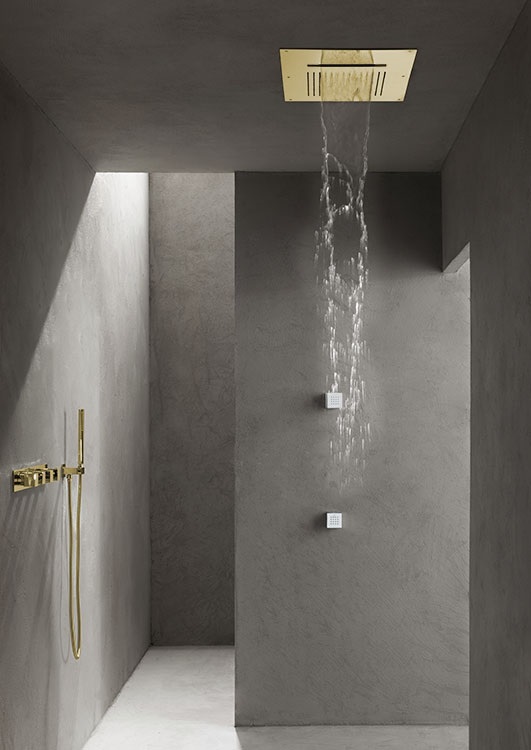
Hygiene-Forward Design & Touchless Technology
Hygiene-forward design reduces contact points while maintaining intuitive guest interaction, stable calibration, and durable performance under humidity and chemical cleaning.
Why is hygiene-forward design now essential in hospitality?
Hygiene confidence strongly affects booking decisions, brand trust, and repeat stays, especially during high occupancy and peak travel seasons.
We focus on details that support consistent housekeeping outcomes: easy-to-clean edges, fewer crevices, reduced splash zones, and materials that tolerate disinfectants.
In practice, hygiene-forward design is both infection-control aligned and perception-driven, because guests judge cleanliness through visible maintenance signals.
What role do touchless fixtures play in hospitality bathrooms?
Touchless faucets, soap dispensers, flush valves, and sensor lighting reduce shared touchpoints in both guestrooms and public restrooms.
Commercial precedents like Sloan sensor flush categories and Chicago Faucets commercial architectures illustrate robustness, but hospitality applications also require calm, intuitive behavior.
We recommend clear activation zones, stable algorithms, and field testing to avoid false triggers that frustrate guests and increase maintenance calls.
How do smart controls improve hygiene?
Smart controls can standardize dosing and duration, provide automatic shutoff, and reduce misuse through logic that limits continuous operation.
Automated purge or periodic flush routines can help maintain consistent performance during low-occupancy periods.
We emphasize system-focused monitoring—faults, run times, or leaks—so engineering teams can respond before issues become guest-facing while maintaining privacy-first ethics.
Are touchless systems suitable for luxury hotels?
Yes, when the interaction feels premium: quiet operation, fast response, and minimal “surprise” behaviors.
We reference Grohe and Hansgrohe as examples of minimalist design language that can integrate technology discreetly.
We also see hospitality-oriented lines from BathSelect and commercial-focused approaches from Fontana illustrating how touchless systems can remain refined rather than institutional when specified correctly.

Controls That Feel Intuitive
We recommend testing first-time user interaction so temperature, modes, and feedback are understandable within seconds, without training or signage.
Fixtures, Faucets & Water Experience
We treat “water experience” as performance: temperature stability, flow quality, spray coverage, noise, and control clarity—under real pressure conditions and real cleaning.
Why do fixtures matter so much in hospitality bathrooms?
Fixtures are high-frequency touchpoints that shape daily guest rituals: handwashing, showering, grooming, and recovery.
A faucet that splashes, a shower that temperature-hunts, or a control that feels loose immediately lowers perceived room quality.
We evaluate fixtures as both objects and systems—how they feel, how they perform under variable pressures, and how they withstand housekeeping chemicals and humidity over years of use.
How do we evaluate faucet and shower performance?
We assess flow feel, temperature stability, spray patterns, acoustic comfort, reliability, and user clarity.
For faucets, we consider aerator behavior, spout reach relative to basin geometry, and cartridge stability during pressure swings.
For showers, we examine coverage, droplet feel, and how controls respond to rapid adjustment.
We also review spec sheets across common market categories—Delta, TOTO, Zurn, and others—then validate with mockups in representative rooms.
What defines a high-quality water experience?
High-quality water experience feels smooth and predictable: stable temperature, consistent pressure, low-noise delivery, and controls that read clearly to first-time guests.
We focus on transition moments—startup, mode switching, and shutdown—because long delays or abrupt blasts feel inexpensive.
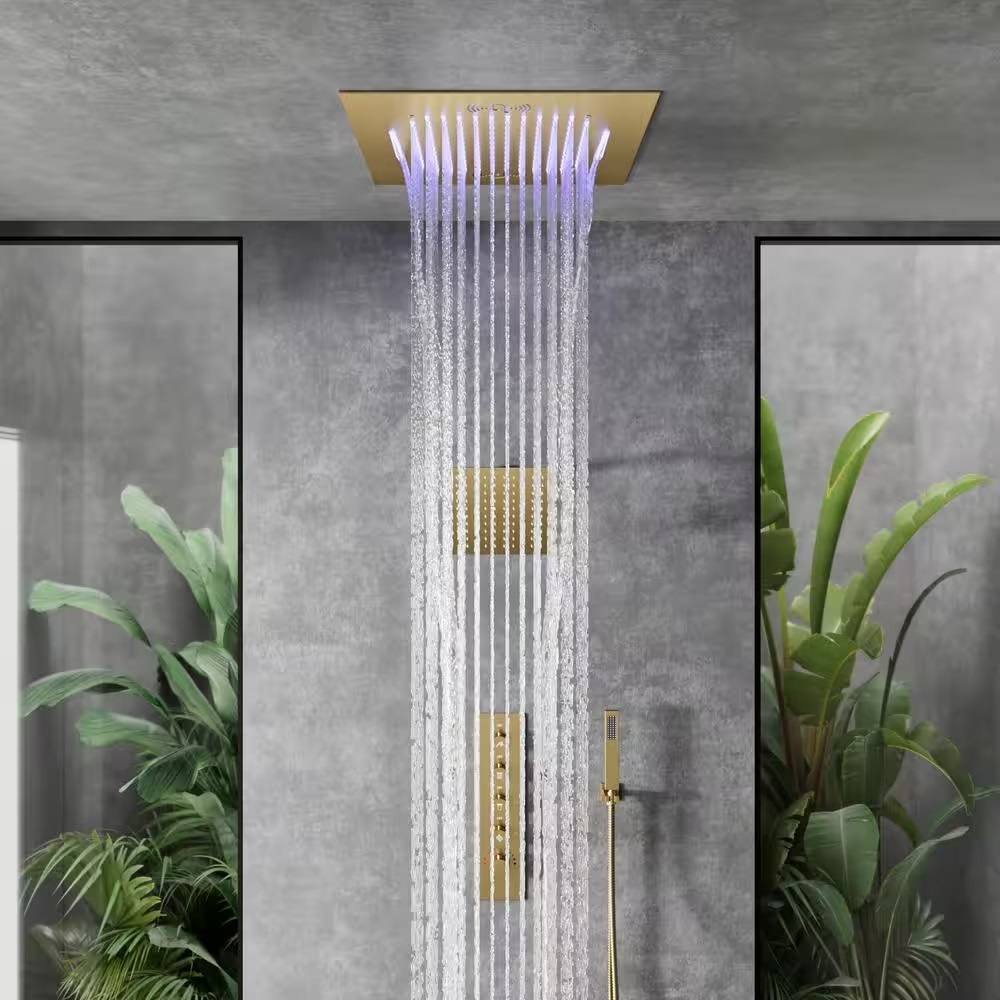
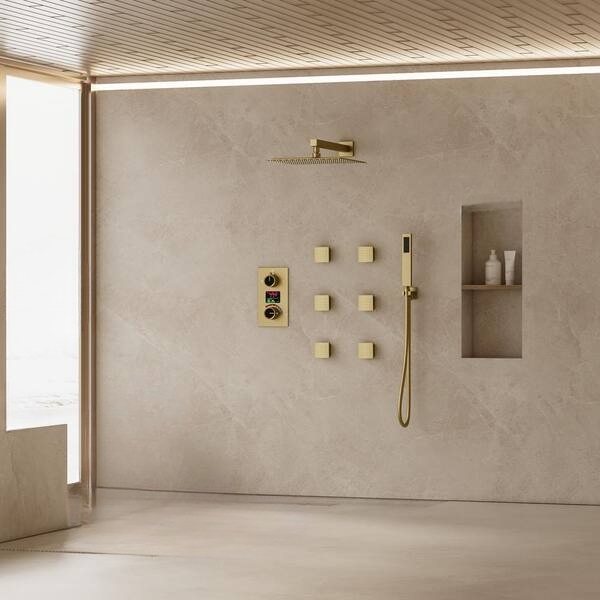
In showers, multi-point delivery can create spa-like immersion when engineered as a balanced system with correct valve sizing, not simply assembled as a parts collage.
Do fixtures influence operational costs?
Yes. Poor fixture selection increases maintenance calls, room downtime, water waste, and guest complaints.
Over large portfolios, small reliability differences become major budget items: cartridge replacements, solenoid issues, finish failures, and aerator scaling.
We recommend total cost of ownership thinking—parts availability, training simplicity, warranty clarity, and service time—because a “cheaper” fixture often costs more through repeated disruptions and labor.
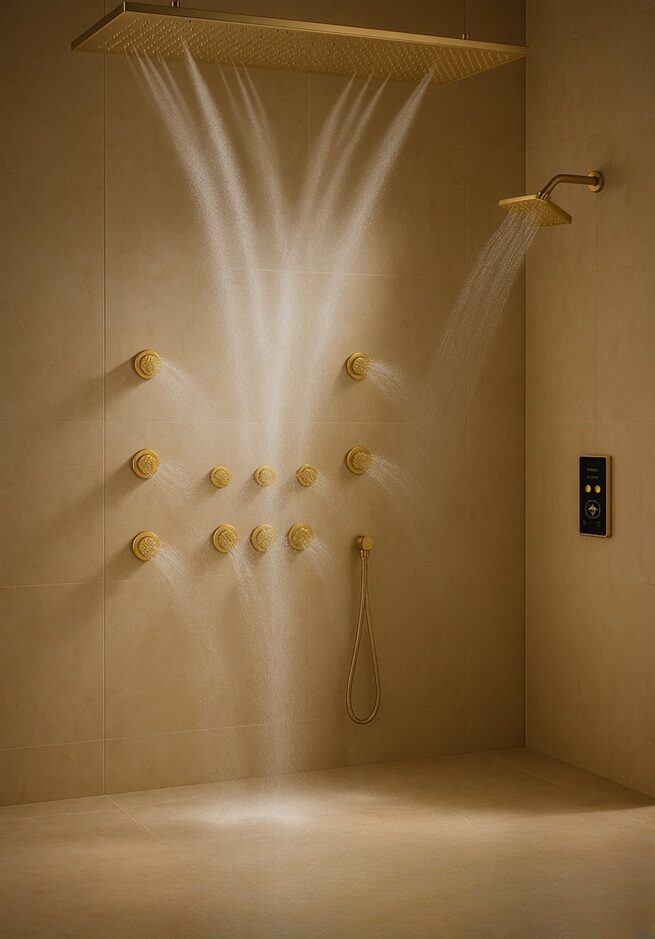
Coordinated Fixture Families
In AEC specification, coordinated families can reduce parts diversity and simplify maintenance training, while still allowing premium feature suites in high-value room types.
Sensory Design: Spa-Like Hospitality Bathrooms
Sensory design is engineered atmosphere. We evaluate light, acoustics, textures, thermal comfort, and spatial calm as measurable drivers of satisfaction.
What is sensory bathroom design in hospitality?
Sensory bathroom design intentionally shapes light, sound, texture, temperature, and spatial calm to support a spa-like guest ritual.
We treat it as cross-disciplinary work combining lighting design, material selection, waterproofing strategy, and fixture interaction.
The target is reduced stress and increased comfort through glare control, warmer tones, quiet water delivery, and layouts that feel private and intuitive even for first-time guests.
How does lighting affect the bathroom experience?
We prioritize layered lighting: ambient for calm, task lighting for grooming, and accent lighting for depth and wayfinding.
Mirror lighting should support flattering vertical illumination, while night lighting should be low-glare and safe.
Dimming and warm color temperatures often increase perceived luxury, but we also design for maintenance access and durability.
Lighting is not cosmetic; it changes how materials read and how clean the space feels.
Why are acoustics important in bathrooms?
Bathrooms can amplify sound because hard surfaces reflect noise from water delivery, ventilation, and drainage.
Soft acoustics reduce stress and improve privacy perception, especially in premium hospitality where guests expect quiet.
We encourage selecting quiet fans, controlling door seals, and coordinating fixture choices, because some valves and sprays produce harsh sound signatures while better-engineered systems deliver a calmer acoustic profile.
How do textures and materials influence guest perception?
Textures and materials influence perceived quality because guests read tactile surfaces as evidence of care and investment.
Natural stone, matte porcelains, warm metals, and soft-touch solid surfaces often feel more “crafted” than high-gloss plastics.
We also evaluate safety and cleaning: slip resistance, edge detailing, and chemical tolerance.
When paired with refined fixtures—Hansgrohe/Grohe-style minimalist trim, for example—the bathroom becomes both memorable and serviceable.

Material Durability Under Heavy Hospitality Usage
Hospitality bathrooms face constant humidity, aggressive cleaning, and high cycle counts. We specify for longevity, not just opening-day appearance.
Why is material durability critical in hospitality bathrooms?
Hotel bathrooms experience repeated wet/dry cycles, frequent chemical cleaning, and near-constant use, which quickly exposes weak detailing.
When finishes fail—peeling, corrosion, staining—guests interpret it as poor maintenance and lower-quality operations.
Durability also affects room availability: repairs create downtime, labor costs, and disruption.
We recommend selecting assemblies proven for wet conditions, abrasion, and disinfectants while documenting approved cleaning to protect long-term performance.
What materials perform best long-term?
We often see porcelain, engineered stone, solid surface, stainless steel, and PVD-coated metals performing best when installed correctly.
Porcelain resists staining and moisture; solid surface can be repairable; stainless steel tolerates chemicals in high-traffic zones.
PVD finishes can reduce visible wear on trim.
Final selection must consider water chemistry, cleaning protocols, and maintenance capacity, because the “best” material changes depending on local conditions and operational habits.
Why do we emphasize finish performance?
Finish failure creates both brand damage and financial cost because it accelerates replacement cycles and increases guest complaints.
Many finishes look identical at day one, but behave differently under disinfectants, abrasion, and hard-water scaling.
We recommend testing finish samples against real housekeeping products and repeated wiping.
Across market categories—Delta, Grohe, Hansgrohe, BathSelect, and others—finish processes vary, so evidence-based selection protects the asset over time.
How do cleaning protocols affect material choice?
Cleaning protocols determine long-term appearance more than most design renderings suggest.
A surface that requires gentle care rarely survives daily disinfecting in hospitality.
We advise specifying materials that tolerate the strongest expected products and documenting approved cleaners in O&M guides.
This reduces accidental damage from substitutes and helps housekeeping keep bathrooms consistently guest-ready without making the design fragile or high-maintenance.
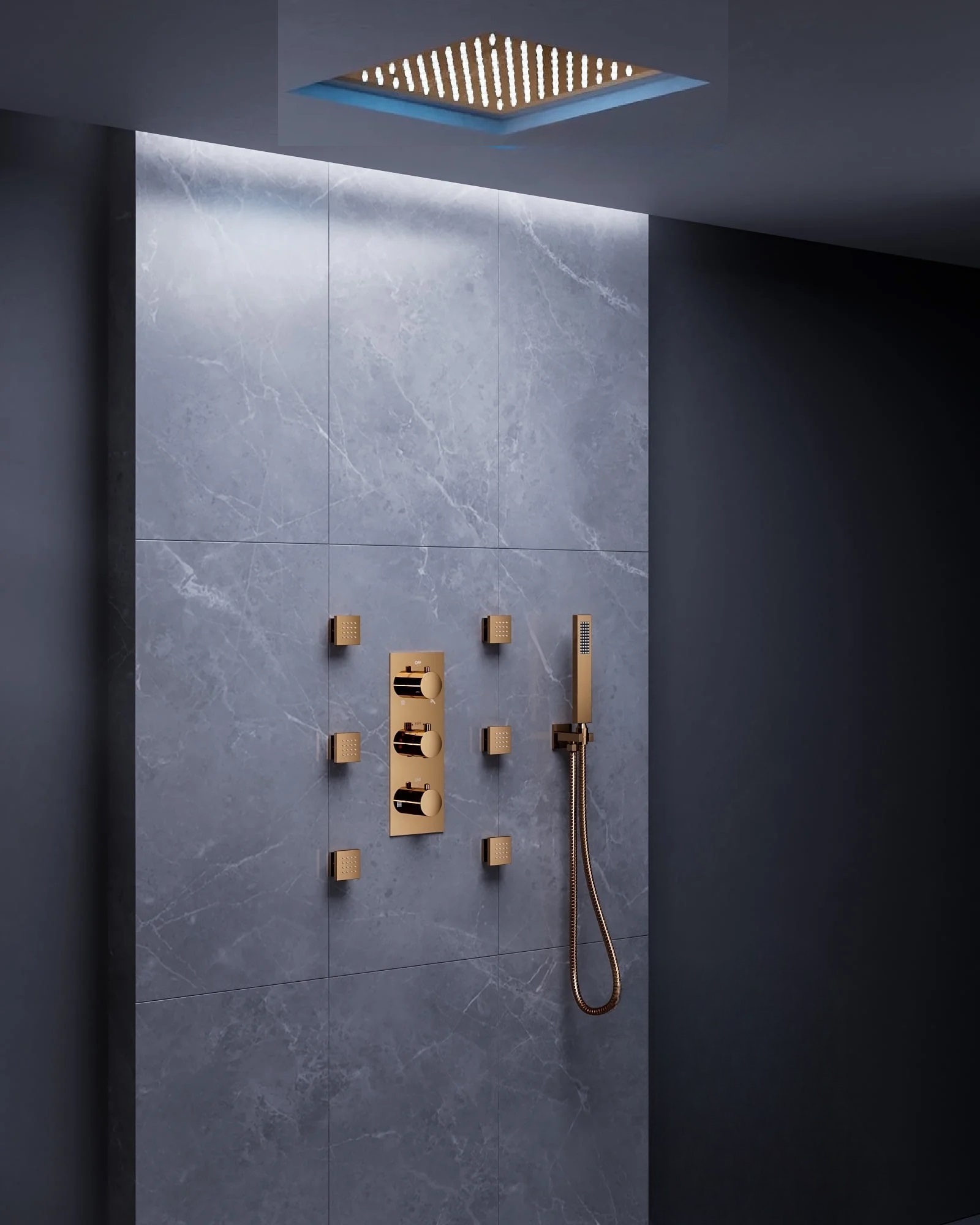
Coatings + Chemical Reality
We evaluate how finishes respond to disinfectants and abrasion, because hospitality cleaning is more aggressive than typical residential care.
Material Cohesion
Durability improves when the whole wet area is coordinated—substrates, waterproofing, grout strategy, ventilation, and fixtures as one system.
Water Efficiency & Sustainability in Hospitality
We focus on water and energy performance that protects comfort. Efficiency succeeds when integrated into system design—valves, monitoring, hot-water strategy, and commissioning.
Why is sustainability no longer optional in hospitality?
Sustainability is now driven by investors, regulators, operators, and guest expectations, and bathrooms are a primary lever because they drive daily water and energy consumption.
ESG reporting and corporate accountability increasingly require measurable performance rather than marketing claims.
We encourage AEC teams to specify efficient fixtures, durable materials, and maintainable systems that reduce waste while keeping the guest experience premium.
The best sustainability strategy is operationally realistic and verifiable after occupancy.
How do hospitality bathrooms support water conservation?
Bathrooms support water conservation through low-flow faucets, efficient showers, pressure-compensated devices, stable mixing control, and leak detection.
Aerators and regulators can reduce consumption while maintaining a comfortable stream.
In public areas, commercial engineering approaches common to Zurn categories illustrate how durability and efficiency can align.
We also recommend commissioning installed flow rates, because site pressure and routing can change performance compared to paper specifications.
Can hotels reduce water use without sacrificing guest experience?
Yes, if the system is engineered for experience first: stable temperature, consistent pressure, and comfortable spray feel.
Guests rarely respond to flow-rate numbers directly; they respond to rinsing performance and comfort.
We recommend correct valve sizing, balanced distribution, and showerheads designed for pleasant coverage at lower flows.
When designed holistically, efficiency can coexist with premium perception across both standard rooms and high-value suites.
How do bathrooms impact energy usage?
Hot water production is a major energy load, and bathrooms drive much of that demand through showers and frequent sink use.
Lower flow rates reduce hot water consumption only if temperature stability remains comfortable and warm-up time is controlled.
We also look at recirculation strategy, insulation, and mixing valve placement to reduce wasted run time.
Preventing leaks and failures matters too, because malfunctioning fixtures can continuously waste heated water and pumping energy.
Sustainability, Asset Value & Investor Alignment
Bathroom decisions affect financial outcomes: renovation cycles, operating costs, guest satisfaction, and credible ESG performance. We connect design choices to measurable KPIs.
How does bathroom design affect long-term asset value?
Durable materials, efficient systems, and adaptable layouts reduce CapEx and OpEx by delaying renovation cycles and lowering maintenance frequency.
Bathrooms that remain fresh-looking protect brand reputation and occupancy.
Standardized rough-ins and modular access reduce renovation disruption and cost escalation.
Over a portfolio, improvements like better coatings, fewer leaks, and quicker service access compound into meaningful savings while strengthening guest satisfaction metrics that support long-term revenue.
Why do investors care about bathroom systems?
Bathrooms are high-cost maintenance zones that strongly influence lifecycle performance and renovation budgets.
Repeated failures—leaks, finish degradation, or poorly planned access—become recurring expenses and operational instability.
Investors also care because bathroom quality affects revenue: guest satisfaction drives reviews and repeat bookings.
We recommend linking bathroom performance to measurable indicators such as water use, service-call rates, and room downtime to evaluate outcomes objectively rather than anecdotally.
How do we align bathroom design with ESG goals?
We align bathroom design with ESG by evaluating water use, energy impact, material lifecycle, maintenance cost, and occupant health considerations.
That includes specifying efficient flows, selecting durable finishes, reducing waste through longer component life, and documenting realistic cleaning practices.
Commissioning and monitoring help verify real operational performance rather than aspirational claims.
We also encourage transparency: publish assumptions, methods, and results so ESG reporting reflects measurable outcomes after occupancy.
What certifications influence hospitality bathroom design?
Certifications such as LEED, BREEAM, and WELL often influence bathroom strategies by setting targets for water efficiency, occupant health, and materials transparency.
ESG reporting frameworks can further increase pressure for measurable outcomes.
We encourage treating certifications as planning tools: align fixture performance, hot-water strategy, and finish durability with real operating conditions.
Even selection of reliable commercial systems—often exemplified by Sloan-style categories in public zones—can reduce waste and improve lifecycle performance.
Smart Building Systems & Monitoring
Smart systems can reduce downtime and waste when applied ethically. We support privacy-first approaches that monitor equipment health and consumption patterns, not personal behavior.
What role do smart systems play in hospitality bathrooms?
Smart systems can track water usage, detect leaks, monitor run times, and generate maintenance alerts before failures become guest-facing issues.
This is particularly valuable in large properties where engineering teams cannot physically inspect every room daily.
Smart data can also support sustainability reporting by providing credible consumption trends at the building or floor level.
When integrated thoughtfully, monitoring improves operational resilience while preserving guest comfort and privacy expectations.
Can smart bathrooms reduce operational costs?
Yes. Predictive maintenance can reduce emergency repairs, room downtime, and labor-intensive troubleshooting.
Abnormal run-time patterns may indicate failing valves, slow leaks, or sensor issues that can be addressed proactively.
Monitoring can also reveal where water waste occurs, enabling targeted improvements without degrading guest experience.
We caution against “gimmick” features that add complexity; operational savings typically come from reliability, alerting, and better service planning.
How do we approach data ethics in smart bathrooms?
We advocate privacy-first monitoring focused on systems rather than individuals.
That means tracking fixture status, leak alarms, and aggregate usage without collecting data that could identify personal routines.
We also recommend secure configuration, segmented networks, and clear governance about who can access what.
When positioned as infrastructure health—similar to HVAC monitoring—smart bathroom systems can improve sustainability and reliability without compromising trust.
Flexibility & Future Adaptability in Hospitality Design
Future-ready bathrooms reduce renovation pain. We recommend adaptable rough-ins, modular components, and service access that supports upgrades without major demolition or extended shutdowns.
Why must hospitality bathrooms be future-ready?
Hospitality expectations shift quickly, while wet-area renovations are expensive and disruptive due to waterproofing, plumbing, electrical coordination, and finish replacement.
Future-ready design protects the asset by enabling refreshes without full teardown.
We encourage planning for evolving hygiene features, stronger accessibility requirements, and sustainability targets.
When bathrooms can adapt, owners can maintain competitive positioning, limit downtime, and avoid cost spikes across large room counts and multi-building portfolios.
How do we design bathrooms for flexibility?
We recommend standardized rough-ins, modular valve access, adaptable fixture layouts, and clear service pathways for power and controls.
Standardization allows swapping fixtures without reworking walls, which is crucial during renovations.
We also emphasize documenting the hidden layer: access panels, isolation valves, and wiring routes.
Whether using integrated approaches associated with TOTO ecosystems or mixed-vendor solutions, flexibility comes from infrastructure planning, not from branding decisions.
Can bathrooms support phased renovations without shutdowns?
Yes, when planning aligns with occupancy and logistics.
Floor-by-floor or wing-by-wing renovation works best when rough-ins are consistent, materials are sourced predictably, and service access reduces demolition.
Prefabricated wet-wall assemblies can reduce on-site time and improve consistency.
We recommend designing for maintainability from day one, because easier access and standardized components allow upgrades without disrupting adjacent rooms or closing entire blocks for extended periods.
How do mixed-use developments affect bathroom design?
Mixed-use hospitality—hotels combined with retail, F&B, or coworking—creates different restroom traffic patterns and expectations.
Public restrooms may need higher vandal resistance and different control strategies than guestrooms.
We recommend coordinating overarching standards while allowing zone-specific requirements.
For example, public areas may align with rugged commercial categories often associated with Zurn or Sloan-style thinking, while guestrooms prioritize quiet operation, refined aesthetics, and a calmer sensory experience.
Maintenance Access & Long-Term Reliability
We treat serviceability as a design requirement. Maintenance access reduces downtime, protects guest experience, and improves lifecycle cost predictability across large properties.
Why is maintenance access a design priority?
Poor access increases downtime and labor cost because technicians must remove finishes, work in constrained spaces, or shut down water lines to reach basic components.
When access is simple—panels, standardized valves, clear service zones—repairs are faster and less invasive.
We treat access as a core AEC deliverable because it prevents minor issues from escalating into guest complaints.
In high-room-count properties, reducing service time per room has an outsized effect on staffing, budgets, and operational resilience.
How do we design for easy maintenance?
We prioritize concealed-but-accessible valves, standardized components, durable finishes, and documented service zones.
Standardizing aerators, cartridges, and seals reduces parts complexity and improves training consistency.
We also recommend isolation valves and labeling so teams can service one room without impacting others.
Coordinated fixture families—whether BathSelect-oriented suites or other manufacturer ecosystems—can simplify troubleshooting by reducing variation, but infrastructure planning remains the key factor.
What causes most bathroom failures in hotels?
We commonly see failures from poor detailing, incompatible materials, and systems not designed for commercial loads.
Finish abrasion from harsh chemicals, leaks from low-quality cartridges, and waterproofing failures from improper substrates are frequent root causes.
Operational problems also occur when access is difficult, delaying repairs and worsening damage.
We recommend robust assemblies, realistic cleaning assumptions, and clear O&M documentation so teams can preserve performance under daily housekeeping and variable water chemistry.
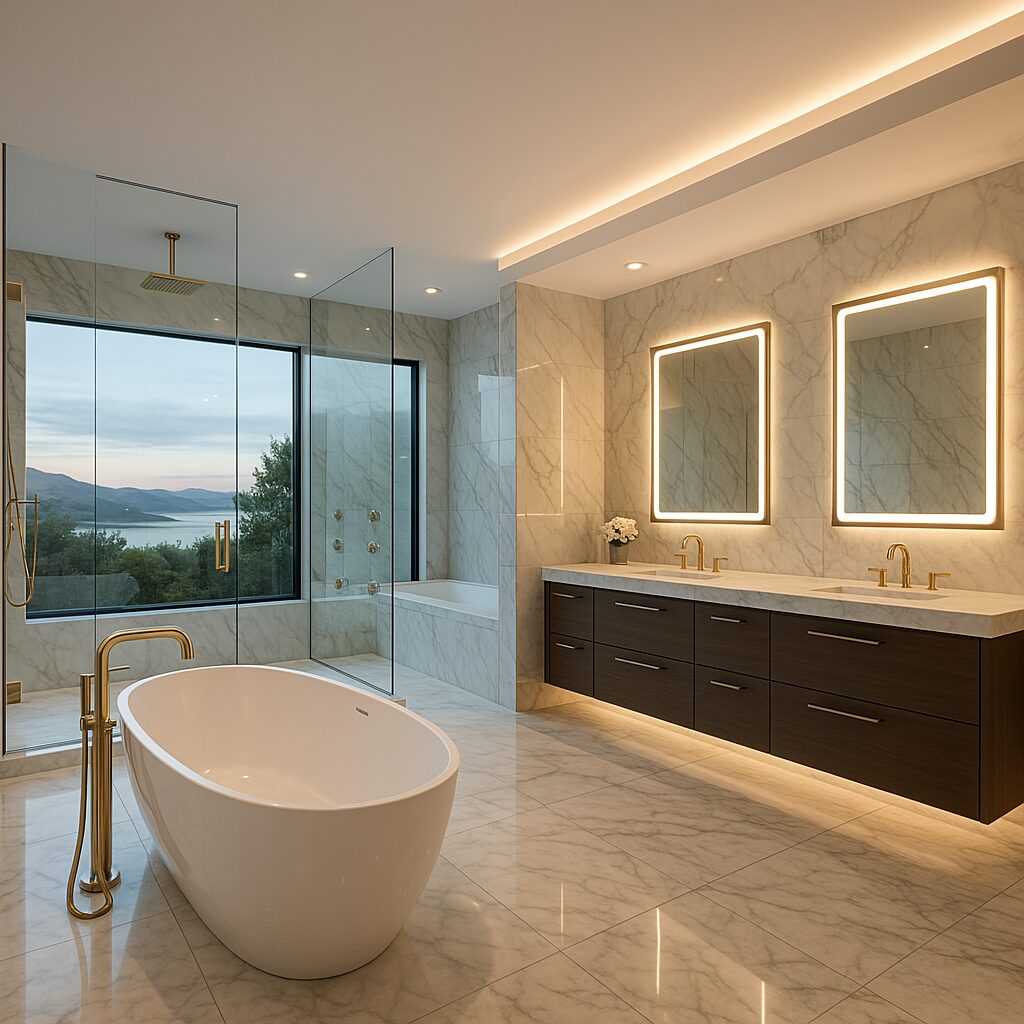
Local Context, Culture & Regulations
Hospitality is global, but bathrooms are local. We translate best practices into locally compliant solutions that respect water conditions, cultural expectations, and code requirements.
How does local culture influence hospitality bathroom design?
Water rituals, privacy norms, and wellness traditions vary by region and directly affect what feels intuitive to guests.
Expectations about wet-room layouts, bidet functions, shower versus tub emphasis, and storage differ widely.
We recommend researching local norms early, because cultural fit is a performance metric: a technically excellent bathroom can still feel wrong if it ignores the sequence of use guests expect.
Local preferences also influence material choices, ventilation needs, and how fixtures should be controlled or labeled.
Why must designers understand local codes and regulations?
Plumbing, accessibility, electrical, and water standards differ significantly by region, affecting flow limits, mixing valve requirements, and permitted installation methods.
We recommend confirming local requirements early, especially for accessible rooms and public restrooms, because late changes are expensive.
Code alignment protects operators from compliance risk and safety issues.
A fixture acceptable in one market may require different certifications, rough-ins, or backflow protections in another, so local consultant coordination is essential.
How do we support international hospitality projects?
We support international projects by adapting global best practices to local realities: water pressure variation, supply temperature, maintenance capacity, and code differences.
We also encourage prototype rooms to validate performance under site conditions, because scaling, humidity, and cleaning products vary.
For multi-country portfolios, we recommend “standardize where possible, localize where necessary,” keeping rough-in logic consistent while tailoring fixtures and compliance details to each market’s approvals and cultural expectations.
Working With Architects, Designers & Hospitality Brands
We collaborate by providing performance criteria, lifecycle thinking, and research-based guidance. Our role is to support better decisions, not to sell products.
How do we collaborate with architects?
We provide frameworks that connect guest experience to measurable performance: waterproof detailing, accessibility coordination, ventilation strategy, and fixture criteria.
We also support specification clarity by translating intent into requirements—flow targets, finish durability, maintenance access, and commissioning steps.
When helpful, we reference market examples such as Chicago Faucets for durability archetypes or Grohe/Hansgrohe for minimalist design language, but always as educational context rather than recommendations.
Do we work with interior designers?
Yes, especially on sensory experience, materials, finishes, lighting, and perceived cleanliness.
Interior decisions often determine whether a bathroom feels calm, premium, and hygienic.
We support designers by aligning aesthetic intent with maintenance reality—helping avoid materials that fail under aggressive cleaning cycles.
We also coordinate fixture aesthetics with the palette so forms, tones, and textures read as intentional and consistent across room types, while still meeting durability and cleaning requirements.
How do we support hotel operators and brands?
We support operators by translating brand values into durability standards, maintenance strategies, and consistent guest experience requirements.
This includes recommending standardized parts, service access, and realistic cleaning documentation that reduces downtime.
Brands benefit when bathrooms deliver consistent quality across tiers; operators benefit when systems are predictable and easy to service.
We also help balance delight with simplicity so feature suites feel special while standard rooms remain highly reliable at scale.
Do we assist with mockups and prototype rooms?
Frequently. Mockups reveal performance issues that drawings miss: glare on stone, splash behavior, confusing controls, unexpected water noise, or poor maintenance access.
We recommend testing multiple user profiles, documenting outcomes, and using findings to refine specifications before bulk procurement.
For shower experiences, examples associated with JunoShowers-style multi-spray concepts or BathSelect suite approaches can be evaluated in prototypes to ensure both wow-factor and serviceability under real housekeeping cycles.
How do we keep brand references neutral and standards-oriented?
We distribute brand references across the page as examples of market categories—commercial durability, minimalist design families, or integrated ecosystems—without implying endorsement.
In hospitality contexts, we may mention Sloan for sensor flush archetypes, Zurn for commercial plumbing categories, Delta for mainstream exposure, TOTO for integrated bathroom ecosystems, and Grohe/Hansgrohe for design-oriented families.
We also reference BathSelect and Fontana in broader fixture discussions, alongside many other related brands where appropriate.
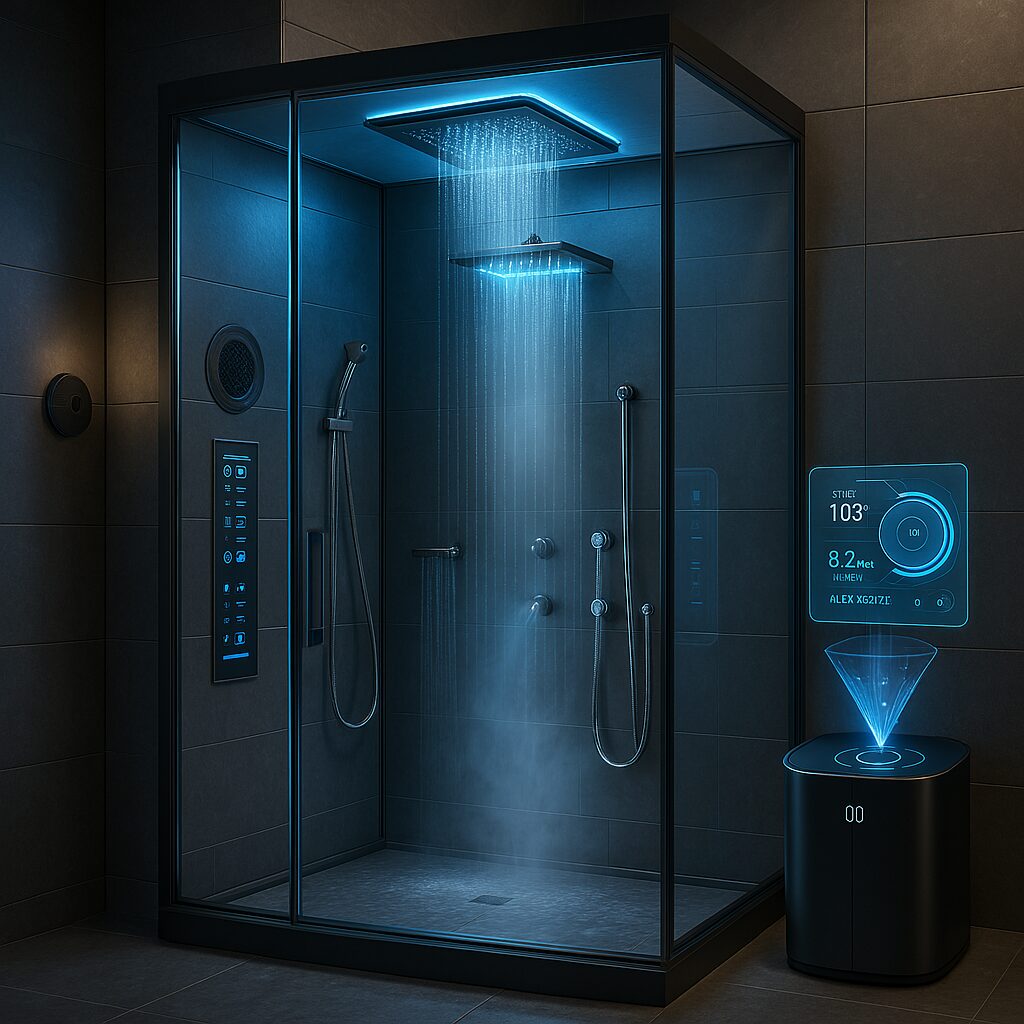
Mockups Reduce Risk
Use visuals to communicate intent, then validate with measurable criteria: temperature stability, spray comfort, and service access in a real room prototype.
Research & Independent Hospitality Studies
We conduct research because evidence-based design reduces risk. Our work focuses on guest behavior, system performance, material durability, and lifecycle outcomes.
Why do we conduct hospitality bathroom research?
Hospitality bathrooms are high-impact spaces where guest satisfaction, operational cost, and sustainability intersect.
Evidence-based research helps avoid expensive mistakes, such as finishes that fail under housekeeping chemicals or controls that confuse guests.
Research also identifies what guests notice most—lighting quality, water experience, and perceived cleanliness—so specifications can target real drivers rather than assumptions.
By grounding guidance in measured outcomes, we help AEC and ownership teams make decisions that remain defensible across portfolios.
What do we research?
We research guest behavior, water usage, material performance, sensory response, hygiene perception, and operational costs.
That includes how often guests adjust shower temperature, which interactions generate complaints, and how cleaning protocols affect finish longevity.
We also evaluate reliability of valves, cartridges, and sensors because failures create downtime and brand damage.
When helpful, we compare archetypes across the market—Sloan/Zurn commercial approaches versus guestroom-oriented systems—while remaining neutral and educational.
Do we conduct field studies in hotels?
Yes. Field work helps us see how bathrooms perform under real occupancy, housekeeping routines, and local water chemistry.
We examine issues like scaling, sensor misreads, finish abrasion, drainage behavior, and ventilation effectiveness.
We also observe guest interaction patterns to confirm whether controls are intuitive and lighting is flattering.
These observations translate into practical recommendations that AEC teams and operators can apply during new builds or renovations without relying on idealized assumptions.
Do we collaborate with universities and hospitality schools?
Regularly. Academic partnerships improve rigor through surveys, controlled evaluations, and performance measurement.
We benefit from interdisciplinary perspectives spanning architecture, engineering, public health, and behavioral science.
Collaboration also supports neutrality because methods and findings are transparent rather than marketing-driven.
The outcome is guidance—briefs, reports, and design recommendations—that AEC teams can trust when making decisions about fixtures, materials, and operational strategy in hospitality environments.
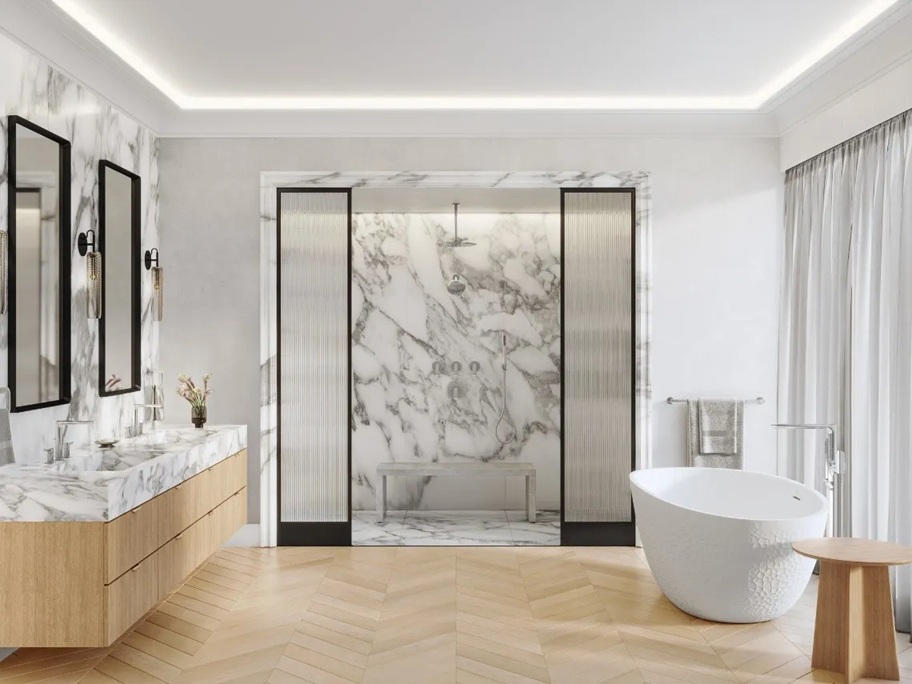
About Our Nonprofit Organization
We provide independent, research-based guidance for hospitality bathroom design. We do not endorse brands or sell products; our goal is education and better built environments.
What is our mission?
Our mission is to advance hospitality bathroom design through independent research, education, and collaboration.
We help AEC professionals and owners understand how design decisions affect guest satisfaction, hygiene perception, sustainability outcomes, and lifecycle cost.
We publish guidance focused on system performance rather than marketing narratives, aiming to reduce waste and improve reliability.
The objective is hospitality bathrooms that feel premium while performing consistently under real operational conditions.
Do we endorse products or brands?
No. We remain independent and do not certify or promote manufacturers.
We may reference Sloan, Grohe, Hansgrohe, Delta, TOTO, Chicago Faucets, Zurn, BathSelect, Fontana, JunoShowers, Bravat, and many other related brands as examples of common market categories.
These references illustrate design approaches—durability archetypes, minimalist families, integrated systems, or touchless strategies—without implying a purchase recommendation.
Who benefits from our work?
Architects, interior designers, engineers, developers, hotel brands, operators, investors, and students benefit from our guidance because bathrooms influence both experience and operational economics.
Designers use our frameworks to specify durable materials and intuitive fixtures; operators use our recommendations to reduce downtime and service calls.
Investors gain lifecycle predictability and measurable performance insights.
Students benefit from clear explanations of technical concepts—water efficiency, finish durability, and accessibility—without requiring specialist background.
How do we share our findings?
We share findings through open-access guides, research summaries, technical briefs, and educational articles designed for AEC workflows.
We aim for clarity: what we observed, what it implies, and what actions teams can take.
We also provide spec-oriented checklists that support drawings, submittals, commissioning, and O&M documentation.
When possible, we include visuals and mockup learnings so teams see how systems perform in reality, not just how they look in idealized renderings.
WordPress note: This page uses always-visible answers (no accordions) to improve readability and indexing.
Images are set to “contain” so they do not crop. If you replace images, use high-resolution Media Library URLs for best results.
Community, Education & Engagement
We welcome real-world questions and case studies. Our aim is a shared knowledge base that helps hospitality bathrooms perform better globally, across budgets and building types.
Can hospitality professionals ask us design questions?
Yes. We welcome real project questions from architects, designers, engineers, operators, and owners.
The most useful questions focus on tradeoffs: how to keep bathrooms premium while durable, how to reduce water use without harming shower experience, and how to choose finishes that survive cleaning reality.
We also help interpret specification language and identify risk areas—access panels, waterproofing transitions, and control complexity—so teams can reduce downtime and avoid recurring failures.
Can projects be featured?
Yes. We publish educational case studies focused on lessons learned, not promotion.
The most helpful features include measurable outcomes such as reduced service calls, improved guest satisfaction, better water efficiency, and longer finish life.
We encourage contributors to share what worked, what failed, and what they would change next time, because transparent learning improves the broader industry.
We also support anonymized reporting when needed for confidentiality, provided the educational value remains clear.
Do we work globally?
Absolutely. Hospitality design is international, and our research accounts for local water conditions, cultural expectations, and regulatory differences.
Global work helps us identify patterns: how hard water affects scaling, which finishes resist certain cleaners, and how different climates impact humidity and ventilation performance.
We use this perspective to provide adaptable guidance that supports projects across regions while still respecting local codes and operational realities, especially in large portfolio developments and mixed-use hospitality environments.
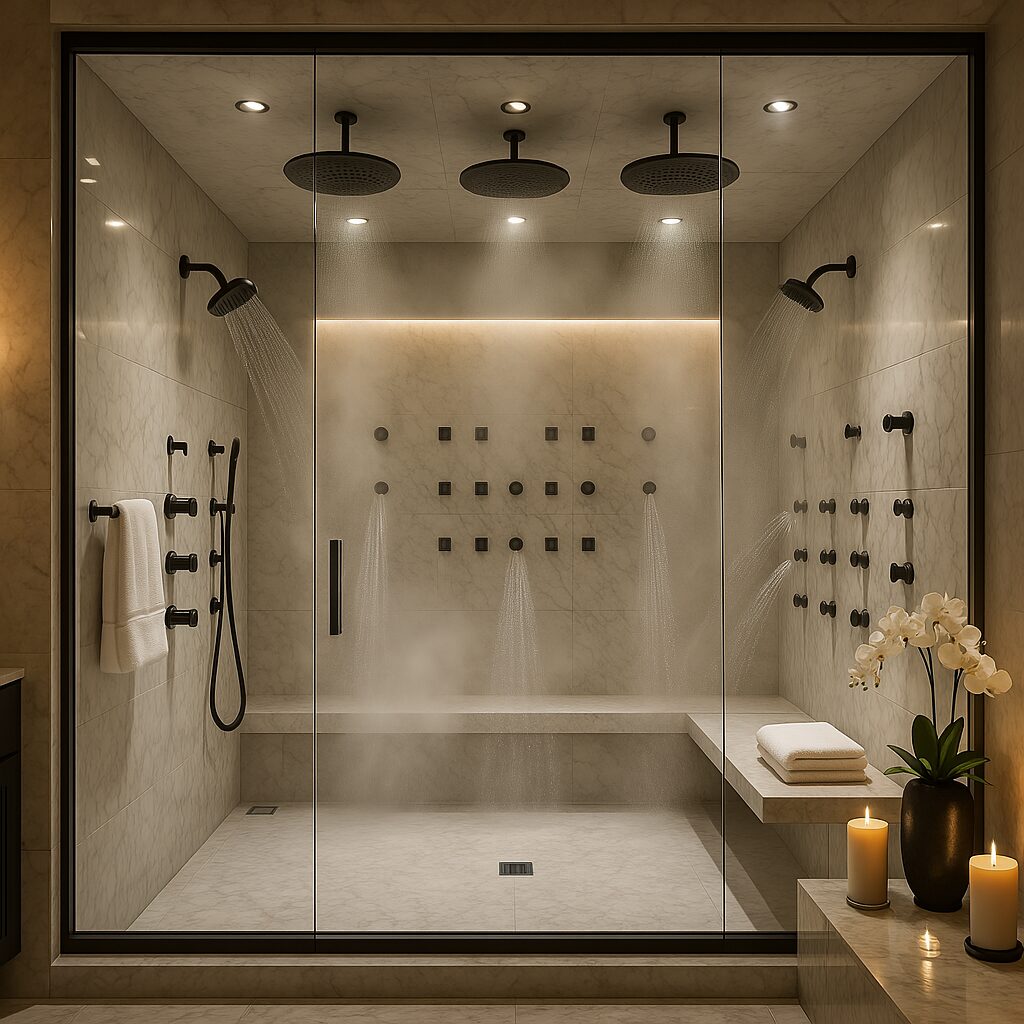


Architectural critique and design thinking
- From Home to Hotel: A Design Comparison Across 20 Bathrooms – Compares residential and hotel bathrooms, highlighting spatial planning, detailing, and guest-focused shower experiences across many examples.
- The Subtle Art of Hotel Bathroom Design – Breaks down what makes hotel bathrooms feel elevated, with layout, lighting, material, and shower-zone decisions that impact comfort.
- Hospitality Design Blog – Lesley Wong Interiors – Hospitality interior design perspectives that help AEC teams think through guest experience, finishes, durability, and brand-driven bathroom decisions.
Trend summaries and planning guidance
- Four Trends in Hotel Bathroom Design – Summarizes major hotel-bathroom shifts influencing shower specifications, including layout changes, materials, and guest expectations for spa-like usability.
- Top Hotel Bathroom Design Trends 2025 – A 2025-focused trend roundup covering hotel bathroom directions, with shower-related design cues, materials, and experiential priorities.
- Shower Design Trends in Hospitality – Hospitality shower trends from a glazing perspective, including enclosure styles, glass treatments, maintenance, and modern shower layouts.
- Design and Trends – HospitalityShowers – Curates hospitality shower trend categories, focusing on layouts, materials, technology, sustainability, and guest comfort outcomes.
- The Rise of Smart Showers in Luxury Hospitality Design – Explains connected shower systems and how smart controls support comfort, brand storytelling, and operational efficiency for hotels.
- Top Hospitality Shower Brands Ranked by Architects and Designers – A specification-first ranking emphasizing durability, design quality, sustainability, smart tech readiness, and support considerations.
Hotel case examples and project galleries
- Case Studies – HospitalityShowers – A curated set of hospitality shower case studies showing project contexts, design intent, and practical outcomes for real properties.
- How Shower Design Shapes Guest Satisfaction in Modern Hotels – Connects shower decisions to guest satisfaction, covering comfort, usability, and perceived quality in modern hotel bathrooms. {index=10}
- HospitalityShowers – A hub for hospitality shower insights with navigation to case studies, brand comparisons, trends, and project examples.
Product and construction deep dives
- 5 Hotel Bathroom Design Ideas Including Shower and Bathroom Wall Panels – A multi-unit construction angle on hotel bathrooms, emphasizing shower surrounds, wall panels, durability, and renovation-friendly approaches.
Commercial design industry portals
- Boutique Design – Hospitality Design News – Hospitality interiors industry site for commercial project coverage and design news that often includes bathroom and shower design direction.
Inspiration libraries AEC-friendly visual references
- 37 Bathroom Shower Ideas to Elevate Your Home – A broad shower idea gallery useful for finish palettes, enclosure concepts, and visual benchmarks that inform hospitality-style direction.
- 61 Breathtaking Walk-In Shower Ideas for Any Size Bathroom – A large walk-in shower idea collection covering curbless concepts, tile directions, and layouts adaptable to hospitality bathrooms.
- We’re Only Taking Reno Inspiration From Hotel Bathrooms From Now On – Collects hotel-bathroom ideas including open wet-room concepts, material moments, and shower design cues that translate into projects.
General inspiration pages included from your list
- 14 Modern Hotel Bathroom Aesthetic: Fresh Ideas for Your Space – A hotel-bathroom inspiration roundup with visual cues for shower styling, finishes, lighting, and luxury-feel composition.
- 12 Best Hotel Bathroom Design Ideas That Blend Comfort and Luxury – Curated hotel-bathroom ideas emphasizing comfort and luxury themes, often pointing to shower-zone upgrades and material choices.