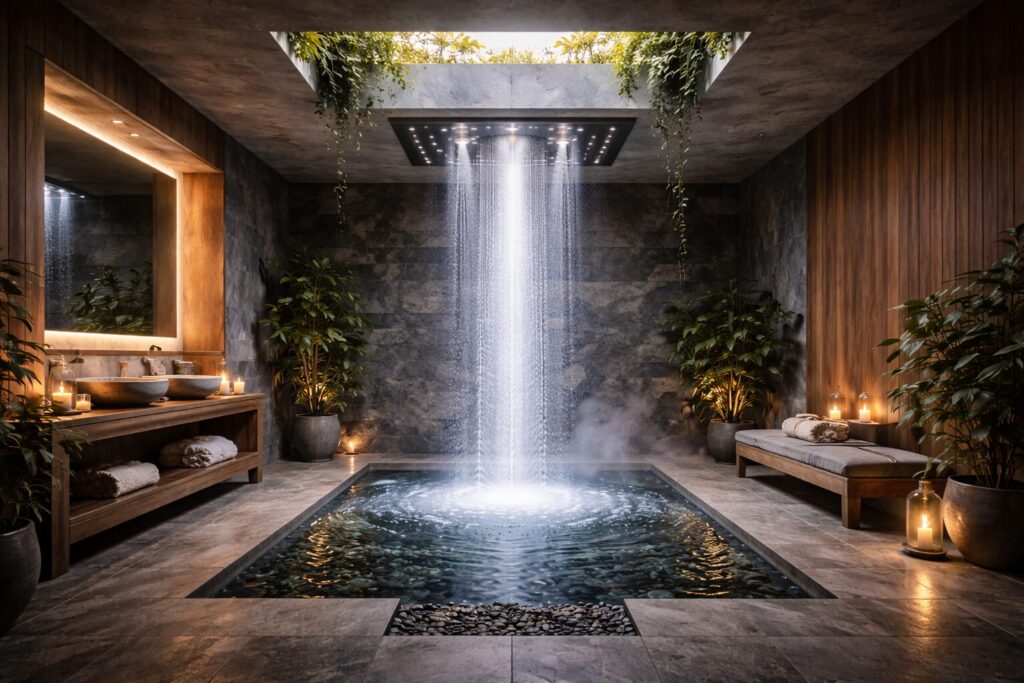
What a “Spa Like” Shower Really Means in a Guest Room

Guest Room Spa Experience
AEC Practical Guide

What a “Spa Like” Shower Really Means in a Guest Room

In hospitality design, a spa like shower is not a decorative upgrade. It is a performance outcome shaped by plumbing engineering,
enclosure detailing, temperature control, acoustics, lighting, and long-term serviceability. For AEC teams, the challenge is delivering
this experience consistently—not just aesthetically.


Luxury hotel guest room shower system

Tip: Use a guest-room shower image that shows head + controls + enclosure quality.

Water Delivery Is About Performance, Not Excess

Coverage, droplet size, and spray force define comfort. Two showerheads with the same flow rate can feel completely different
depending on internal engineering and pressure behavior across floors.

Spray mechanics

Coverage, droplet size, and spray force define comfort. Look for engineered patterns that feel “full” at modern flow caps.

Rain shower head coverage pattern

Pressure consistency

Guest-room systems must perform across floors and pressure zones without relying on user tweaks or excessive flow.

Thermostatic shower control valve detail

Temperature Stability Builds Trust

A spa like shower never surprises the user. Stable temperature under pressure changes and outlet switching is achieved through properly selected
and commissioned automatic compensating mixing valves.

ASSE 1016 thermostatic valve installation
Hotel shower temperature control testing

Commissioning matters
High-limit stops + pressure swing testing + outlet switching tests should happen before turnover.

The Enclosure Is Part of the System

Drainage detailing, waterproofing continuity, and service access drive long-term guest satisfaction and reduce maintenance callbacks.

Drainage and slope

Proper slope and drain placement prevent standing water, improve drying time, and reduce odor or slip complaints.

Waterproofing continuity

Continuous membranes and well-detailed penetrations are essential for long-term performance behind tile and trim.

Serviceability

Access to valves and cartridges without tile removal protects finishes and reduces downtime during room turns.

Acoustics + lighting

Quiet ventilation and glare-free lighting complete the “spa” perception, even when flow is efficient.

AEC Checklist for a Spa Like Guest Room Shower

Use as design gate + turnover checklist
This reduces comfort complaints, leak risk, and downtime.

Performance + comfort

  • Verified spray performance, not just flow rate
  • Coverage feels full at code flow limits
  • No harsh jets or “needle spray”

Temperature + safety

  • ASSE 1016 compliant temperature control
  • Commissioned high-limit temperature stops
  • Stable under pressure changes + outlet switching

Hydronics + operations

  • Coordinated hot water recirculation strategy
  • Debris screens + flushing plan
  • Service parts availability documented

Enclosure + building health

  • Continuous waterproofing and verified slope
  • Quiet ventilation and glare-free lighting
  • Service access without tile removal

Relevant Product Category References

All buttons open in a new tab.

Technical Sources and Support Documents

All sources open in a new tab.

Designing the Perfect Hotel Shower Experience: Comfort Meets Innovation

Designing the Perfect Hotel Shower Experience: Comfort Meets Innovation
Hospitality · Showers 2025

Designing the Perfect Hotel Shower Experience: Comfort Meets Innovation

In the evolving world of hospitality, the shower is no longer just a functional component — it has become a key touchpoint of guest satisfaction and brand differentiation. For hotel operators, designers and engineers, creating a shower experience that combines comfort, operational efficiency and forward-thinking technology is now essential. Below, we explore how to design the perfect hotel shower experience in 2025 by integrating guest comfort, smart innovation and long-term performance.

Hero — replace with your preferred hotel shower image
1

Prioritising Guest Comfort from Start to Finish

Comfort begins the moment the guest enters the bathroom. That means delivering consistent water temperature, good water pressure, seamless user controls, and an environment that feels calming rather than purely utilitarian. Design commentary indicates that bathrooms are increasingly being re-imagined as sanctuary spaces rather than purely functional zones. Source: (see button below)

Key design elements include: a rainfall or waterfall head for sensory impact; a handheld wand for flexibility; bench seating or niche for convenience; ambient lighting or chromotherapy for mood ambience. A guest entering the shower should feel they are entering a well-designed, soothing environment, not simply washing.

2

Smart Technology & Personalisation — The Expectation, Not the Extra

Technology in the hotel shower is no longer optional luxury; it’s becoming an expectation. According to research, smart shower systems that include IoT sensors, personalized presets, flow monitoring and connectivity are gaining traction. Source: (see button below)

In a hotel context this can mean: digital control panels or touch interfaces where guests select temperature/flow modes; memory presets linked to loyalty programmes or guest profiles; occupancy sensors to monitor water wastage and compliance; integration with the broader room control system (lighting, climate, water). For the specifier or engineer, ensuring infrastructure is in place (power, data, network) and that the shower system can talk to the building management or guest-experience layer is vital.

Smart spec checklist
  • Digital mixers with presets + thermal safety limits
  • API/Protocol compatibility with PMS/BMS
  • Usage analytics & leak/flow anomaly alerts
3

Seamless Integration of Sustainability and Efficiency

High-end hotels increasingly recognise that luxury and sustainability are complementary. Guests value brands that act responsibly, and design needs to reflect that. One sector-analysis noted that sustainability, smart tech, open-plan layouts and efficiency are shaping hospitality design. Source: (see button below)

In the shower zone this translates into design decisions such as: low-flow aerated heads that feel full-flow; thermostatic mixing valves for temperature stability and energy savings; leak-detection sensors and automatic shutoff; long-life materials that reduce replacement and refurbishment frequency; prefabricated modules to reduce construction waste. For operational teams, this means total cost of ownership needs to be considered up-front.

4

Accessibility, Universal Design & Operational Durability

Luxury also means inclusivity and reliability. Guest comfort includes making the space work for all body types and mobility levels, and operational durability is critical in high-turnover hotel environments. A study on tub-to-shower conversions in hotels highlighted how designing larger, curbless showers improves accessibility and maintenance. Source: (see button below)

Features to include: zero-threshold entry, wide door or open walk-in shower, integrated bench, handheld wand, slip-resistant flooring, concealed drain channels. From a durability standpoint: fixtures must be robust, finishes must withstand high use and cleaning cycles, service access must be straightforward.

Universal design quick specs
  • Zero-threshold entry & 36” clear approaches
  • Grab bars integrated with finish palette
  • Thermostatic scald protection; anti-slip flooring
5

Materiality, Detailing & Experience-Driven Design

The shower experience is tactile and visual. The choice of materials, finishes and spatial arrangement directly influence how the guest perceives value and comfort. According to a trend piece on hotel bathroom design, materials and shapes are evolving — organic forms, curved surfaces, natural materials and biophilic design elements are gaining ground. Source: (see button below)

For the shower this could mean: wall-mounted controls that are intuitive and minimal; large-format tile or stone slabs to reduce grout lines; frameless or fully glass enclosures for openness; integrated lighting in niches/benches; curves or softened corners to enhance comfort. Specifiers should balance aesthetic ambition with maintenance realities (cleaning, durability, re-sealing) especially in hospitality settings.

6

Planning for Serviceability, Lifecycle & Brand Story

A great hotel shower is not just what guests see, but how well it performs over time. The design must factor in brand story (what the hotel stands for), user experience (what guest expects) and operational reality (maintenance, replacement cycles). Hospitality design experts emphasise that the bathroom is becoming part of the brand narrative rather than simply a functional after-thought. Source: (see button below)

Key planning considerations:

  • Choose fixtures and controls with service parts available globally (important for chain hotels).
  • Consider modular shower pods or pre-fab units to simplify refurbishment and reduce downtime.
  • Coordinate early with MEP, controls, waterproofing, housekeeping and maintenance teams.
  • Monitor guest feedback specific to the shower/en-suite experience and iterate design in subsequent room refresh cycles.
7

Stitching Comfort + Innovation + Brand in One Seamless Experience

Ultimately, the perfect hotel shower experience lies at the intersection of comfort, innovation and brand coherence. Guest comfort is delivered through performance (water, pressure, temperature, space), innovation through smart technology and operational excellence, and brand coherence through material, finish, and narrative alignment. For designers and hotel engineers this means: treat the shower as a destination within the room; specify the technology early; ensure the operability and maintenance strategy; and align finishes and controls with the hotel’s brand promise.

In summary, designing hotel showers today calls for a holistic mindset: one that blends guest-centric comfort, smart functionality, sustainability, accessibility and brand storytelling. Hotels that deliver these experiences will not only satisfy guest expectations but set new standards in hospitality excellence.

When to Replace a Shower System Instead of Repairing It

Hospitality shower planning & design guidance

When to Replace a Shower System Instead of Repairing It

Modern Marble & Glass Shower

A practical overview of modern hotel shower design—from guest experience and layout choices to plumbing comfort, smart-shower tech, and lifecycle sustainability. Use the contents to jump to the section you need.

Contents

Quick tip:
If you’re scanning, start with layout & materials and plumbing comfort—these two sections usually drive the biggest guest satisfaction gains.

The shower as an experiential space

Shower design in hotels blends comfort with technical features like durability, accessibility, and sustainability.
These spaces are more than functional; they serve as places of relaxation and wellness, boosting guest satisfaction
and operational efficiency.

Today’s hotel showers aim to provide unforgettable experiences. Guests expect personalized, luxurious spaces,
with features like rainfall showerheads and body jets reflecting a desire for indulgence.

Layout, geometry, and material performance

Eco-friendly designs are essential in hotel showers. Low-flow fixtures and efficient plumbing balance luxury with
sustainability, helping hotels meet their environmental goals while providing a premium experience.

Accessibility is a priority. Hotels are increasingly integrating universal design, including wide entrances and
grab bars, ensuring safety and comfort for all guests.

Plumbing performance and user comfort

Shower design in hotels blends comfort with technical features like durability, accessibility, and sustainability.
These spaces are more than functional; they serve as places of relaxation and wellness, boosting guest satisfaction
and operational efficiency.

Spa-Inspired Open Shower
Design takeaway:
When a shower “feels premium,” it’s often because water delivery is consistent and comfortable—stable temperature, reliable pressure, and intuitive controls.

Technology as an integrated design element

Technology is reshaping the shower experience. Smart showers with voice control, personalized settings, and
entertainment features allow guests to customize their shower, turning it into a truly immersive experience.


Sustainability and lifecycle considerations

Eco-friendly designs are essential in hotel showers. Low-flow fixtures and efficient plumbing balance luxury with
sustainability, helping hotels meet their environmental goals while providing a premium experience.

Integrating the shower into a cohesive bathroom system

Accessibility is a priority. Hotels are increasingly integrating universal design, including wide entrances and
grab bars, ensuring safety and comfort for all guests.

Technical reference categories

If you’re researching specs and product categories, you can cross-check the sources below and jump back to
Contents anytime.

What to verify while specifying:
Water efficiency targets, material durability, cleanability, slip resistance, and accessibility dimensions—then match these to your maintenance realities and guest expectations.

Sources Used in the Article

All links open in a new tab.

Hotel Bathroom Renovation Checklist That Prevents Costly Mistakes

UNFORESEEN EXPENSES
RENOVATION CHECKLIST

Hotel Bathroom Renovation Checklist That Prevents Costly Mistakes

A practical checklist focused on coordination, code triggers, durability, waterproofing, and turnover testing—built to reduce RFIs, rework, and change orders.

Hotel bathroom renovation checklist

Replace this hero image with your featured project photo (optional).


Quick risk map

These are the repeat “cost multipliers” that cause rework and change orders in hotel bathroom projects.

Waterproofing

  • Penetrations, transitions, flood tests
  • Approved assemblies (not just brands)
  • Inspection gates before tile

Rough-ins

  • Valve depths and trim compatibility
  • Drain heights, slope, chase access
  • MEP coordination early

Accessibility

  • Clearances, reach ranges, accessories
  • Blocking and mounting heights
  • Room-type compliance checks

Turnover

  • Leak checks and drain performance
  • Hot water delivery and stability
  • Commissioning before guest use

The renovation checklist

Use these items as pre-design gates and construction-phase checks. Each tile is written to reduce rework risk.

1) Existing conditions survey by room type

  • Count every bathroom type (standard, suites, accessible, connecting)
  • Photograph valve locations, drain elevations, chase depth, vent routing
  • Capture repeat failures (leaks, odors, scald complaints, mold points)

2) Performance targets before finishes

  • Define flow targets and hot water delivery expectations
  • Confirm temperature limit policy and anti-scald approach
  • Require chemical compatibility for finishes and sealants

3) Accessibility and code triggers

  • Verify clear floor space, turning, and reach ranges
  • Dimension accessories from finished surfaces
  • Coordinate grab bar backing and mounting heights

4) Shower valve and drain strategy

  • Choose valve type and control logic early
  • Confirm outlet counts and simultaneous flow
  • Match drain body, slope, and membrane system

5) Waterproofing details as a complete system

  • Define membrane, primer, seam tape, and sealants
  • Detail penetrations for valves, body sprays, spouts
  • Schedule flood tests before tile starts

6) Ventilation and humidity control

  • Verify exhaust rates and controls (continuous or demand)
  • Coordinate make-up air and door undercuts
  • Confirm fan noise targets and duct routing

7) Touchless fixtures with commissioning plan

  • Choose power type and confirm access for maintenance
  • Validate sensor line-of-sight with basin, mirrors, lighting
  • Define shutoff timing and hygiene behaviors if used

8) Accessories backing and penetrations coordination

  • Confirm backing for grab bars, seats, dispensers
  • Coordinate GFCI, lighting, and junction boxes
  • Provide one dimensioned accessories plan per room type

9) Maintenance-first specification

  • Standardize cartridges, aerators, sensors, solenoids
  • Place access panels discreetly but logically
  • Require spare parts list and troubleshooting guide

10) Turnover functional testing

  • Leak checks and drain performance
  • Hot water delivery time and temperature stability
  • Exhaust verification and touchless calibration in actual lighting
Field tip
Add “stop points” in the schedule: waterproofing inspection, flood test, rough-in verification, and commissioning. Those gates prevent late-stage surprises.

Detail image frames

Replace these placeholders with your own photos, plan excerpts, or installation details.

Valve depth & wall build-up
(replace with detail image)
Call out finished surface to rough-in depth.
Waterproofing penetration detail
(replace with detail image)
Show approved sealing method for penetrations.
Drain height, slope & membrane
(replace with detail image)
Confirm drain body + membrane compatibility.
Accessible clearances & reach ranges
(replace with detail image)
Verify clearances per room type.
Touchless sensor field-of-view
(replace with detail image)
Validate line-of-sight with lighting and mirrors.
Ventilation + door undercut strategy
(replace with detail image)
Confirm exhaust and pressure balance.

Support documents and links

All links open in a new tab.

How to Choose Showerheads That Feel High End at Any Price

AEC Practical Guide
Showerheads

How to Choose Showerheads That Feel High End at Any Price

A technical, non-salesy selection guide for architects, engineers, and specifiers.
Focus on performance feel, pressure realities, water efficiency, and long-term serviceability.

Updated: December 19, 2025

Audience: AEC

Topic: Showerheads

High end showerhead selection guide hero image

Replace with a project-relevant image: rain head, handheld rail, or valve + head coordination.

What Makes a Shower Feel Expensive

Premium feel is not just flow. It is spray quality, coverage, pressure behavior, noise control, and maintenance reality.

1) Spray engine tuned for low flow

Look for real performance claims at your target gpm. A good spray plate can feel full at 1.8 to 2.0 gpm if coverage and droplet sizing are engineered.

Spray pattern diagram placeholder
Coverage diagram placeholder

2) Pressure behavior in real buildings

Multi story and mixed occupancy buildings see pressure swings. Choose heads and controls that avoid harsh jets at high psi and weak rinse at low psi.

Pressure range illustration placeholder

3) Quiet, stable, and easy to service

High end feel fades when a head whistles, scales up, or clogs. Favor easy clean nozzles, accessible screens, and replaceable flow components.

Nozzle material placeholder
Service parts placeholder

AEC Selection Workflow

A simple process that reduces RFIs, avoids comfort complaints, and improves long-term maintainability.

A) Set the code and owner constraints first

Define the max flow, jurisdiction requirements, and any WaterSense or local efficiency targets.

B) Define “premium feel” as measurable goals

Coverage, spray intensity, rinse off time, noise tolerance, and expected pressure range at the outlet.

C) Coordinate valve strategy and water quality risk

Thermostatic vs pressure balance. Include debris screens, line flushing, and scale plan in O and M.

Rain head install placeholder
Rain head install coordination image.
Handheld rail placeholder
Handheld rail + accessibility planning.
Valve coordination placeholder
Valve + head coordination detail.

Quick Spec Checklist

Copy into your fixture schedule notes and submittal requirements.

Performance

  • Max flow: ____ gpm at 80 psi (verify jurisdiction)
  • Operating pressure range documented: ____ to ____ psi
  • Spray type: rain, focused rinse, or mixed
  • Coverage: uniform distribution, no harsh needle jets
Performance notes placeholder

Durability and Maintenance

  • Body material: brass or stainless preferred
  • Nozzles: easy clean anti scale
  • Service parts: screens, restrictors, seals available
  • Commissioning: flush lines before final trim
Maintenance plan placeholder
Tip
If the project has pressure swings, prioritize documented operating range + stable spray feel at low flow.

Category Links for Design Coordination

Use these as starting points for finishes, head types, and system coordination. Buttons open in a new tab.

BathSelect note
Add verified BathSelect and any other category URLs by duplicating a card and replacing the link.

Source Links

All sources open in a new tab.

Simple Bathroom Changes That Make a Room Feel New

Bathroom refresh playbook
Low disruption upgrades
Maintenance-friendly

Simple Bathroom Changes That Make a Room Feel New

A practical refresh framework for AEC teams focused on minimal disruption, better user experience, and easier maintenance.
Use the cards below as a quick scope checklist that feels like a planned renovation (without moving rough-ins).


Hero image: add a sharp bathroom photo (wide crop works best).

Tip: Keep one finish family across faucets, accessories, and shower trim—instant “new room” effect.

Fast wins that read like a renovation

Biggest perceived change with the smallest scope. Keep rough-ins. Improve finishes, usability, and cleanliness cues.

Field tip
Before ordering, mock one room: confirm lighting tone, mirror glare, and faucet splash behavior.

Upgrade cards

Swap in your own images inside each card. Buttons open in a new tab.

1) Replace what users touch first

  • Standardize trim + finish across lavatories
  • Improve sensor tuning if touchless is used
  • Confirm flow rate and tempering strategy

Image: faucet + soap pairing

2) Reduce splash and standing water

  • Match spout projection to bowl geometry
  • Swap aerators for cleaner stream pattern
  • Field-test “landing zone” near drain

Image: aerator + splash control

3) Upgrade lighting and mirrors

  • Even illumination at mirror plane
  • Reduce glare and improve color consistency
  • Keep drivers + service access practical

Image: mirror + lighting upgrade

4) Unify hardware and accessories

  • Pick one finish family
  • Use concealed fasteners + solid backing
  • Reduce SKUs for maintenance simplicity

Image: unified accessories

5) Refresh joints and edges

  • Recaulk wet joints with correct sealant
  • Regrout selectively where staining shows
  • Investigate recurring failure causes

Image: grout + sealant refresh

6) Update shower trim without moving plumbing

  • Replace showerhead + handshower set
  • Verify valve compatibility + service access
  • Confirm pressure range + flow control

Image: shower trim upgrade

Reference links and standards

Buttons open in a new tab. Use these for spec language and review checklists.

Designing Showers for Luxury Without Blowing the Budget

AEC Practical Guide · Luxury Feel on a Real Budget

Designing Showers for Luxury Without Blowing the Budget

Luxury is a performance outcome—not a price tag. This guide shows how to prioritize spray feel, temperature stability, enclosure detailing, and maintainability so guest rooms feel premium without expensive scope creep.

Category starting points (open in new tab)

Buttons · New tab

Luxury signals that don’t require luxury pricing

Image frames
Spray coverage placeholder

Spray coverage + comfort

Coverage and droplet feel matter more than raw flow numbers.

Temperature stability placeholder

Stable temperature

Consistency reads as premium. Sudden swings ruin trust immediately.

Clean detailing placeholder

Clean detailing

Fewer ledges and seams = easier cleaning and “newer” appearance longer.

Priority choices that create a luxury experience

High impact
Showerhead engineering placeholder

1) Spend on spray feel, not just finishes

Two heads with the same gpm can feel completely different. Spray engine quality is a “luxury multiplier.”

  • Prioritize coverage and droplet comfort at your actual gpm.
  • Pick heads that hold performance across a realistic pressure range.
  • Choose easy-clean nozzles to keep the “new” feel longer.
Valve stability placeholder

2) Make temperature stability non-negotiable

Luxury showers don’t surprise guests. Stability comes from valve selection, balancing, and commissioning.

  • Confirm mixed outlet stability under simultaneous-use conditions.
  • Specify service access for cartridges and stops.
  • Document setpoints and high-limit settings for turnover consistency.
Enclosure geometry placeholder

3) Let enclosure geometry do the work

Better spray containment and faster drying reduce complaints and keep rooms feeling premium longer.

  • Coordinate head location, spray envelope, and drain position.
  • Reduce splash-out with smart glass placement and curb/threshold detailing.
  • Detail for cleanability: fewer ledges, better transitions.
Service access placeholder

4) Design for maintenance, not hero repairs

A luxury room stops feeling luxury the first time tile has to be opened for a simple fix.

  • Standardize parts and provide access panels where failures happen.
  • Reduce SKUs so staff can fix issues fast across the property.
  • Include simple inspection points in close-out documentation.

Budget moves that matter most

Best ROI
Lighting placeholder

Lighting + mirror clarity

Upgrade perception immediately: glare control, consistent CCT, and even mirror illumination.

Handshower placeholder

Handshower as “premium utility”

Guests notice usability. Staff notice faster cleaning. Both improve with a good rail setup.

Drain cleanout placeholder

Drain cleanability

Clean drains and fast drying reduce odors and repeated maintenance calls.

Where budgets get wasted

Common traps

Finish upgrades with weak performance underneath

  • Expensive trim cannot compensate for unstable temperature or weak spray feel.
  • “Luxury look” fails if scale and debris reduce performance quickly.
  • Prioritize serviceability so the room stays premium after year one.

Uncoordinated systems that increase RFIs

  • Head placement not aligned with glass and drain causes splash, pooling, and complaints.
  • Missing access planning turns simple cartridge work into destructive repairs.
  • Too many SKUs raises inventory cost and slows fixes across the building.

Spec-ready checklist

Copy into spec / CA notes

Performance (luxury feel)

  • Verified spray coverage and comfort at the project gpm target.
  • Defined pressure range at outlet and documented performance expectations.
  • Handshower usability and rail placement coordinated with guest needs.

Reliability (keep it premium)

  • Stable temperature strategy + commissioning documentation.
  • Service access to cartridges, stops, and key joints.
  • Drain and enclosure details designed for quick cleaning and fast drying.
Checklist image placeholder
Replace with a markup diagram, mockup photo, or manufacturer-neutral system detail.

Helpful references (open in new tab)

EPA WaterSense showerheads
Open
WaterSense showerhead specification (PDF)
Open
ASME supply fittings standard page
Open
ADA 2010 Standards (for usability planning)
Open

The Most Common Shower Complaints in Hotels and How to Fix Them

AEC Field Guide · Hotel Plumbing + Shower Performance
The Most Common Shower Complaints in Hotels and How to Fix Them
A practical troubleshooting and design checklist for architects, engineers, and hotel operators. Focused on temperature stability, flow performance, drainage, moisture control, and maintainability.
Visual Checklist Gallery

Temperature Stability

Valve selection, balancing, and commissioning prevent hot cold swings.

Flow and Spray

Separate pressure from flow. Check strainers, cartridges, and head scaling.

Drainage and Slope

Drains must be maintainable and spray envelopes must stay inside the wet zone.

Service Access

Access panels and standardized cartridges reduce downtime and destructive repairs.

Complaint to Root Cause with Practical Fixes

1) Temperature swings and sudden hot or cold shocks

Common causes: pressure disturbances, unstable recirculation, worn cartridges, cross-connection mixing.

  • Use shower temperature control strategies that limit outlet swings during pressure disturbances.
  • Balance and verify recirculation under diversified load, not only no load.
  • Standardize service parts and provide access panels for fast cartridge changes.

Field checks (fast, repeatable)

  • Measure mixed outlet stability while neighboring fixtures run.
  • Confirm stops and strainers are clean after renovation work.
  • Run simple isolation tests to detect crossflow conditions.
Spec Ready Checklist

Temperature Control and Stability

  • Deliver stable mixed outlet temperatures under realistic simultaneous use.
  • Balance and verify hot water recirculation return temperatures under load.
  • Commission and document temperature limit settings and operational targets.
  • Provide service access and standardize cartridges and trim.

Flow, Spray, and Maintainability

  • Differentiate pressure vs flow during troubleshooting and commissioning.
  • Specify accessible stops and serviceable strainers.
  • Verify a sample of rooms for flow performance during turnover.
  • Maintain a repeatable maintenance kit and room-by-room log.
Sources and Support Documents

ASME Valve Performance

EPA WaterSense Showerheads

FontanaShowers Main Website

BathSelect Main Website

Rain Shower vs Handheld for Hotels: What Guests Prefer

Hospitality Design AEC Detailing

How to Make a Small Hotel Bathroom Feel Premium

A compact guest bath can feel high-end when the layout is clear, the lighting is controlled, surfaces are detailed cleanly, and fixtures behave predictably. Use this as a technical checklist for decisions that still hold up on day 400.

Premium small hotel bathroom hero frame
Feature wall + calm lighting (replace with your WP media image).

1) Layout and perception in tight footprints

Premium starts with a clear plan. In small bathrooms, visual noise and awkward circulation make everything feel cheaper. Keep sightlines open, limit pinch points, and align key elements so the room reads intentional.

Keep a clean entry view

  • Place mirror and vanity as the first focal plane.
  • Avoid immediate visual clutter from towels and bins.
  • Use a single “feature surface” rather than many accents.
Small bathroom layout clarity

Lift fixtures off the floor where practical

  • Floating vanity improves perceived floor area.
  • Cleaner housekeeping reset lines.
  • Less visual weight in narrow rooms.
Floating vanity and floor plane

Reduce visual barriers

  • Clear glass keeps the room from feeling chopped up.
  • Minimize heavy framing and dark thresholds.
  • Plan water containment so the floor stays dry.
Glass enclosure continuity

2) Materials that read premium and survive housekeeping

Choose fewer materials, then detail them precisely. Large-format tile and clean terminations reduce grout clutter and make a small room feel calmer.

Large format tile and clean joints
Fewer grout lines.
Edge profiles and transitions
Clean edges.
Countertop splash and durability
Easy wipe zones.

3) Lighting and controls that instantly feel higher-end

The fastest upgrade is lighting uniformity at the mirror. Use layered lighting (face + ambient + night), avoid direct glare in the mirror, and keep color temperature consistent.

Mirror lighting

  • Prefer vertical light around the face.
  • Control glare and reflections.
  • Two-circuit setup improves usability.
Vertical face lighting at mirror

Ambient + night

  • Wide beam ambient avoids corner darkness.
  • Night light reduces late-night eye strain.
  • Warm neutral tone reads more relaxing.
Ambient lighting coverage and comfort

Hidden sources

  • Coves and concealed strips add depth.
  • Soft gradients feel more “designed.”
  • Less direct view of the emitter.
Cove lighting and soft illumination

4) Treat the shower as a performance system

Guests notice temperature stability and intuitive control placement. For AEC teams, valve selection and service access drive long-term performance.

Temperature stability

  • Thermostatic mixing supports consistent comfort.
  • Reduces complaint risk during pressure changes.
  • More predictable guest experience.
Thermostatic mixing and stability

Control logic

  • Controls reachable without stepping into spray.
  • Clear labeling and simple mode switching.
  • Hand shower adds flexibility in tight stalls.
Control placement avoids spray

Maintenance reality

  • Confirm access panels for valves where needed.
  • Choose finishes compatible with cleaners.
  • Minimize crevices that trap soap scum.
Service access and maintenance

5) Fixtures and touchless strategy (where it actually helps)

Touchless feels premium when sensors are tuned correctly for basin geometry and when service is planned (power strategy, access, shutoff timing). WaterSense guidance is useful for setting efficiency targets without killing user comfort.

Sensor + basin coordination

  • Confirm sensor range and response time.
  • Reduce false triggers from reflective surfaces.
  • Set shutoff timing for waste prevention.
Touchless faucet and basin geometry

Accessibility and operability

  • Plan clearances and reach ranges early.
  • Keep operable parts intuitive for all guests.
  • Compliance can still look refined.
Ergonomics and operable parts

Housekeeping reset speed

  • Less horizontal ledge area means fewer water spots.
  • Choose coatings that tolerate cleaning chemistry.
  • Design for day-400 appearance.
Housekeeping reset speed and finishes

Sources and category links

All links open in a new tab.

The Shower Upgrade That Raises Guest Satisfaction Scores

Hospitality Plumbing Guest Satisfaction

The Shower Upgrade That Raises Guest Satisfaction Scores

Guests don’t rate showers by finish. They rate outcomes: stable temperature, consistent spray during peak hours, obvious controls, low noise, and fewer “broken shower” moments.

Hotel shower upgrade feature image
Replace with a real photo (example: hotel-shower-upgrade-temperature-stability.jpg).

What raises guest satisfaction in one sentence

A shower feels higher-quality when temperature stays stable, spray stays consistent, controls are obvious, noise is low, and maintenance issues are rare.

Four drivers that actually move reviews

1) Temperature stability

Specify acceptance checks for response time and stability under realistic pressure swings.

2) Spray performance at efficient flow

Guests notice coverage and force. Verify performance at the property’s operating pressure range.

3) Controls guests understand fast

Control confusion becomes a negative review. If first-time users hesitate, simplify the interface.

4) Maintainability and downtime

Service access and standardized parts reduce “out of order” rooms and repeat complaints.

Image frames to make the post feel “real”

Swap each placeholder with your WordPress media library URL.

Thermostatic mixing valve in hotel guestroom shower
Temperature stability hardware.
WaterSense showerhead spray pattern coverage example
Spray coverage and force.
Shower control ergonomics and accessibility considerations
Controls and accessibility.

Hospitality shower upgrade checklist

Copy into specs and commissioning notes.

Performance and comfort

  • Temperature stability criteria under defined pressure changes
  • Time to reach stable mixed temperature
  • Spray coverage and perceived force at operating pressure
  • Noise/vibration acceptance in mockup rooms
  • Simple controls and predictable diverter behavior

Commissioning and lifecycle

  • Mockup test with non-project staff + ops
  • Commissioning verification with recorded measurements
  • Service access strategy + spare parts plan
  • Finish compatibility with housekeeping chemicals
  • BIM coordination to reduce field conflicts

Category links

Buttons open in a new tab.

Source links

All sources open in a new tab.